

Stars in 3D: Overview
Introduction
There are over 100 billion stars in our Milky Way galaxy. Galaxies3D explores two extremes:
In these views, Galaxies3D anchors the stars to a "base" grid parallel to the galactic plane.
The Brightest Stars and their Spiral Arm
In showing the brighest stars and star clusters and nebulae in the Milky Way, Galaxies3D makes extensive use of a modified version of the European Space Agency's (ESA) 2025 map of the Milky Way based on data from the Gaia satellite. The map is a view of the plane of the Milky Way viewed from the perspective of the North Galactic Pole. The image is used to help make clear:
The European Space Agency's (ESA) 2025 Milky Way map shows the Milky Way possesses several spiral arms, relatively equally prominent:
NOTE: Prior to 2025, Galaxies3D used a modified version of the 2008 image of the Milky Way Galaxy by Robert Hurt of NASA and JPL-Caltech, based on data from the Spitzer Space Telescope. Click here for information on the differences between the 2008 NASA map and the 2025 ESA map.
The Sun lies in the Orion Arm. The very small yellow circle marking the position of the Sun in the Orion Arm has a radius of 750 light years. The larger red circles are spaced every 5000 light years from the Sun. The lines of galactic longitude radiate from the Sun across the vast galactic disk:
The galactic disc is slowly rotating in a clockwise direction, the spiral arms trailing. At the position of the Sun, the galactic rotation will take about 220 million years to complete one full rotation (sometimes called a "galactic year").
As we travel towards the galactic center from the Sun in the Orion Arm, the next spiral arm we encounter is the Carina-Sagittarius Arm. As we travel away from the galactic center, the next spiral arm we encounter is the Perseus Arm:

The majority of bright stars we see from Earth lie within that small yellow 750 light year radius circle marking the sun in the above images. The Galactic center lies about 26,000 light years from the sun, so the 750 light year radius is about 2.9% of the way to the Galactic center.
To put some numbers on the comment about "the majority" of stars, in exploring the stars of each constellation, Galaxies3D includes all stars brighter than visual magnitude 4.5 — about 925 stars. This magnitude limit includes nearly:
At this limit, 815 visible stars lie within the 750 light year radius circle marking the Sun's position. 110 stars (about 12%) lie outside the circle, most lying within 2000 light years of the Sun and well within the Orion Arm. The notable exceptions are labeled in the image below from Galaxies3D of stars brighter than magnitude 4.5, and farther than 750 light years:
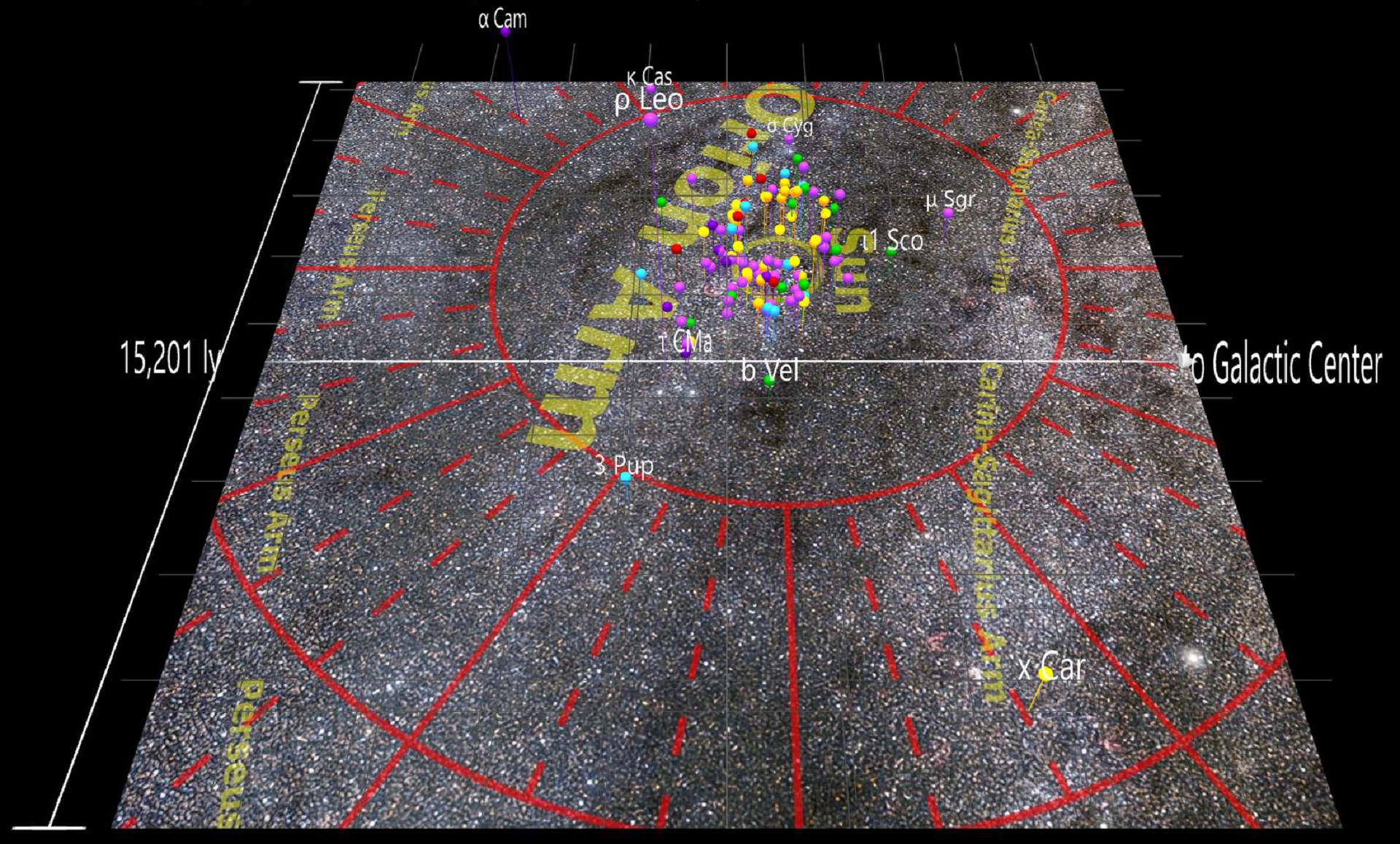
If a constellation's displayed stars (= all stars brighter than magnitude ~4.5) include stars at or outside the 750 light year radius circle marking the Sun's location on the European Space Agency's (ESA) Milky Way image, Galaxies3D will display the magnified patch of the ESA Milky Way Galaxy image, scaled to the grid, in its 3D view of the constellation. That 750 light year radius circle will often appear highly magnified in the view, as in this image of stars in constellation Centaurus:

If a constellation's displayed stars (= all stars brighter than magnitude ~4.5) are all contained within the 750 light year radius circle, Galaxies3D does not display the NASA Milky Way image, as in this image of stars in the constellation Bootes:

Nearest Stars
In displaying our Sun's "next store" neighboring stars, Galaxies3D paints onto the base galactic plane grid a NASA bitmap of the local interstellar medium:

In this view of all known stars and brown dwarfs up to 16.3 light years from the sun, the color coding of stars by their spectral type helps make it clear that the majority of the stars near the Sun are small, long-lived red main-sequence M-stars. Standing out in this view is the closest star system to the sun, the triple-star system containing α Centauri, a yellow G2 main sequence star just like our Sun, and the blue A1 main sequence star Sirius:

A subset of the above view shows the stars and brown dwarfs within 11 light years of the sun:

Bright Stars, Near Stars, Solar Systems
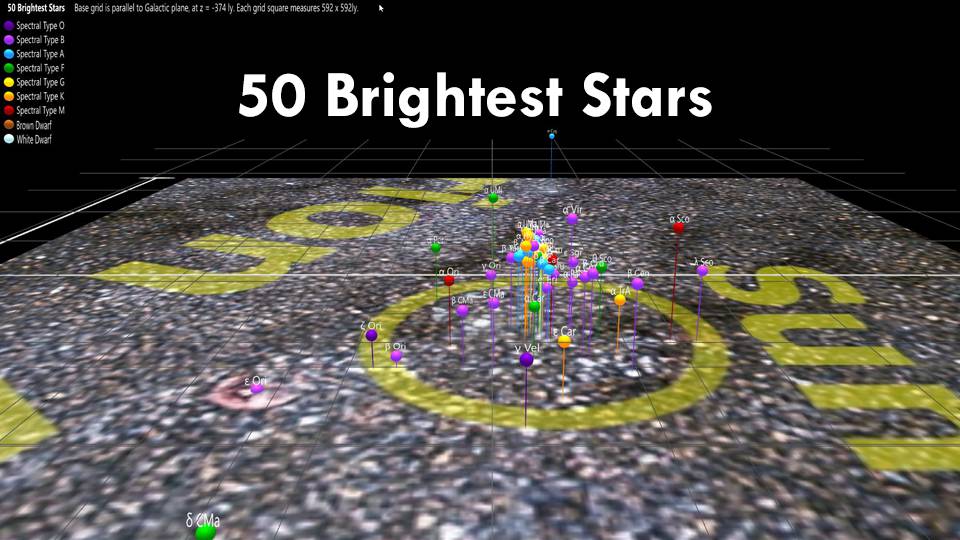


Bright Stars in the Constellations


The Constellations and the Galactic, Supergalactic Planes


